
Build Your Sublimation Gang Sheet
Upload, size, duplicate, and arrange artwork online. Mix graphics and quantities while filling the available sheet area efficiently.
Best for: mixed designs, apparel runs, and maximizing sheet value
Permanent color with no raised print layer
Order full-color sublimation prints for white or light polyester apparel and compatible polymer-coated hard goods. Build a gang sheet, upload a finished layout, or choose individual pre-cut transfers.

Choose your ordering path
Choose by how your artwork is prepared and how much trimming you want to do. Every product card uses live Shopify data for its image, starting price, and availability.
Upload, size, duplicate, and arrange artwork online. Mix graphics and quantities while filling the available sheet area efficiently.
Best for: mixed designs, apparel runs, and maximizing sheet value
Send one complete production layout at the ordered dimensions. This route is ideal when your sheet has already been prepared and checked.
Best for: designers, repeat layouts, and established production teams
Receive separate transfers that can move directly to blank alignment and pressing without trimming a gang sheet first.
Best for: repeat designs, simple distribution, and faster handling
Sublimation fundamentals
Sublimation transfers carry printed dye that becomes permanent color inside compatible fibers or coatings during heat pressing. The finished apparel keeps its natural surface feel because there is no separate film layer.
On apparel, polyester content controls how much dye can bond. At least 65% polyester is the practical minimum for a deliberate vintage or muted result, while 100% polyester gives the strongest and most predictable color. Any cotton portion remains undyed and can make the print look softer after pressing and washing.
On hard goods, the base material alone is not enough. A ceramic mug, metal panel, or tumbler must have a sublimation-compatible polymer coating. Products that merely look similar can react differently, so use blanks from a reliable supplier and follow the blank maker’s press settings.
Under heat and pressure, sublimation ink turns into gas and bonds with compatible polyester or polymer coating. As the item cools, the color becomes part of the material rather than a raised layer on top.
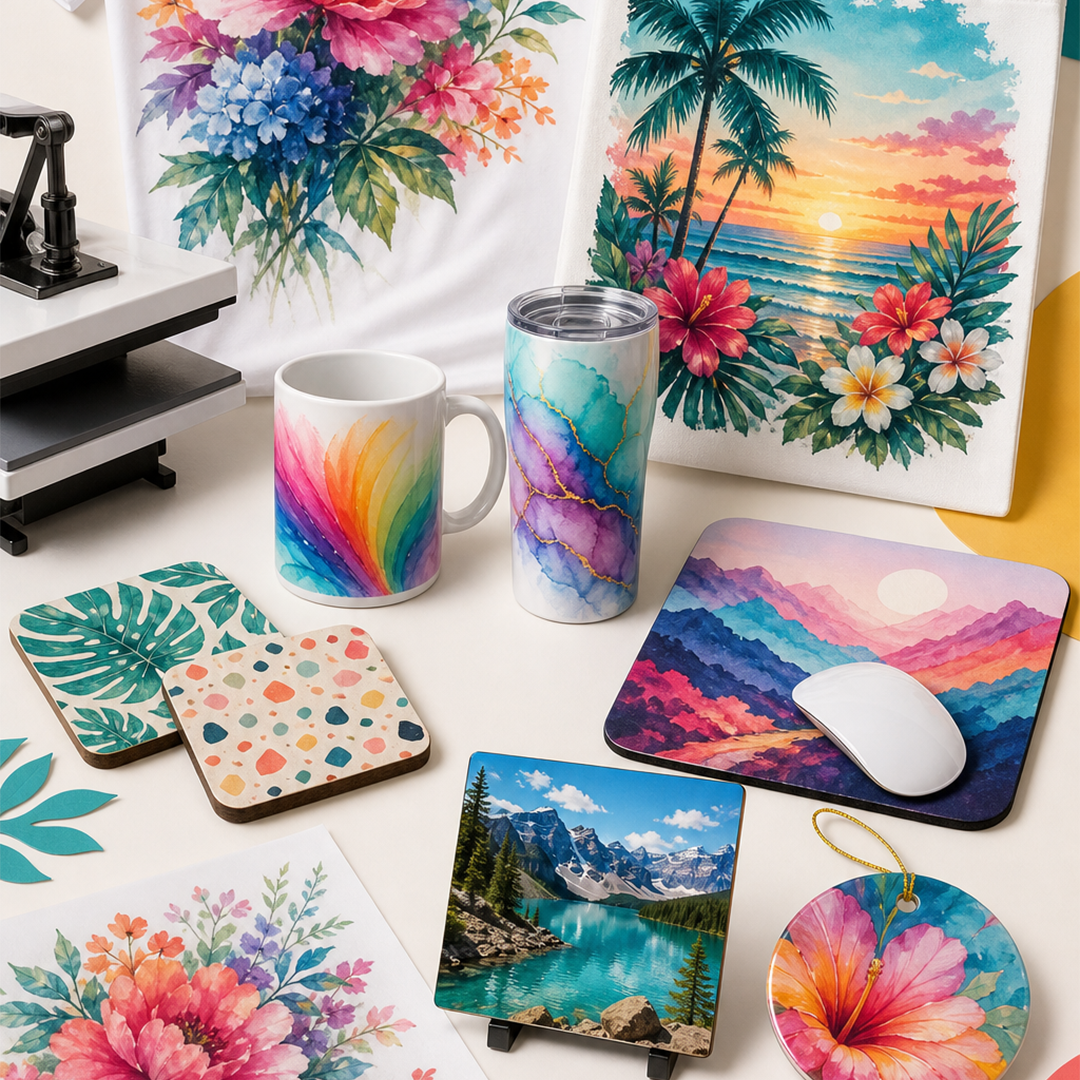
Sublimation suits performance apparel, teamwear, photo gifts, mugs, tumblers, coasters, mouse pads, license plates, and other products specifically sold as sublimation-ready.
Sublimation ink has no white. It needs white or light polyester apparel or a compatible light-colored coated blank. Dark cotton and ordinary uncoated products will not produce the intended result.
Substrate compatibility
Sublimation is exceptionally durable on the right blank and disappointing on the wrong one. Read apparel labels and product specifications rather than choosing by appearance alone.
Heat tolerance matters too. Some fabrics can scorch, shrink, show press marks, or reveal dye migration. Some coated blanks require a mug press, convection oven, special wrap, or shaped platen rather than a flat heat press. Test an unfamiliar blank and document the successful settings before production.
| Material or blank | Fit | What to know |
|---|---|---|
| White 100% polyester apparel | Best result | Produces the most saturated, predictable color and permanent dye behavior. |
| Light apparel with 65–99% polyester | Works with softer color | Lower polyester content creates a more muted or vintage result. |
| Dark polyester apparel | Not recommended | There is no white ink; garment color shows through the printed dye. |
| Cotton apparel | Not recommended | Sublimation dye does not permanently bond to untreated cotton fibers. |
| Sublimation-coated mugs, tumblers, metal, and hard blanks | Recommended | Use the blank maker’s time, temperature, pressure, and cooling instructions. |
| Ordinary uncoated glass, ceramic, wood, or metal | Not compatible | The required polymer coating is missing. |
Size and production planning
Apparel placements use familiar width ranges, while hard blanks often require exact manufacturer templates. The best measurement is always taken from the actual item.
For shirts, compare the design width with the smallest garment in the run and keep the entire transfer on a level platen. For mugs and tumblers, build around the true printable area and decide whether the artwork is front-facing, double-sided, or a full wrap. Tape placement and press geometry need room too.
Sublimation paper can show color that looks dull before pressing; the heat reaction produces the final result. Do not evaluate an unpressed transfer as if it were a finished color proof. For exact branded color, approve a pressed sample on the intended blank.
Account for seams, collars, zippers, tapered walls, handles, and platen size. On hard goods, use the blank supplier’s printable-area template when one is available.
For edge-to-edge hard-blank coverage, extend artwork beyond the final visible area as the blank template directs. A transfer that ends exactly at the edge can leave an unprinted sliver if alignment shifts.
Keep enough space to cut and handle each transfer without damaging the printed area. Group sizes and quantities before building so operators can identify every piece quickly.
A quick visual break
Sublimation makes more sense when customers can see the pale printed sheet, the compatible blank, and the finished color. Both panels accept approved images or Shopify-hosted videos.
Sublimation transfers look dull and washed on the sheet before pressing. Once it is pressed it comes out with full vibrancy just how you're expecting it. Dye sublimation is the most resistant and will last as long as the item.
A lot of sublimation items benefit from tailored presses. Tumblers, mugs, and other round objects come out better if using heat presses specifically made for them.
Artwork preparation
Sublimation reproduces full-color artwork beautifully, but it cannot cover a dark substrate. Treat the blank’s existing color as part of the design.
Use the ordering product’s current file guidance. A transparent high-resolution PNG is suitable for many graphics, while template-driven hard goods may be easier to prepare in design software that preserves exact dimensions. For upload-ready gang sheets, match the file canvas to the ordered size and keep every item within bounds.
Confirm whether the production workflow handles mirroring; follow the live product instructions rather than guessing. Before checkout, inspect names, numbers, dates, orientation, and quantities. Same-day production moves quickly, so a production-ready file should already be approved.
Prepare artwork at final print size, preferably 300 DPI. Clean edges, correct spelling, and adequate source resolution are essential; enlarging a small web image does not restore detail.
White areas in the file become the color of the blank. Pale colors can shift when pressed onto colored fabric, so design with the substrate color in mind.
Review semi-transparent elements, shadows, gradients, and profiles at actual size. Order a pressed sample when color tolerance is tight or the blank coating is new.
Good versus incompatible
This side-by-side check turns the most important compatibility rule into a quick visual decision for first-time customers.
The substrate is white or light, rich in polyester, or sold as sublimation-ready. Artwork is high resolution and secured so it cannot move during pressing.
Sublimation has no white ink and cannot permanently dye untreated cotton or ordinary uncoated products. Choose DTF or a compatible coated blank instead.
Pressing and care
Good sublimation depends on controlled heat transfer. Prepare the blank, secure the print, protect the equipment, and remove the transfer without movement.
Pre-press apparel briefly to remove moisture and flatten the area. Lint-roll first because invisible fibers can become blue specks under heat. Allow hard blanks to cool as their manufacturer directs; some coatings can be damaged by sudden temperature change or unsafe handling.
On polyester apparel, sublimation color is designed to last 70+ washes when applied and cared for as directed. Wash cool with mild detergent and avoid bleach or high heat. Hard-blank care follows the blank manufacturer’s guidance. A coating may require hand washing even though the sublimated image itself is permanent within that coating.
Time, temperature, and pressure vary by garment and coated blank. Follow the supplier’s current specification and use a calibrated press with even contact.
Use heat-resistant tape where appropriate and keep the transfer from shifting as the press closes or opens. Lift paper cleanly without sliding it across the hot item.
Use fresh protective paper above and below the application as needed. Sublimation dye can pass through fabric or remain on press surfaces and contaminate later jobs.
Verify polyester content or sublimation coating and the blank maker’s settings.
Pre-press apparel; clean hard blanks and protect the press.
Place the printed side against the blank and tape to prevent movement.
Use the blank-specific temperature, time, and pressure.
Lift paper cleanly without sliding to prevent ghosting.
Pricing and turnaround
Starting prices are pulled from Shopify in the ordering cards. Final cost depends on sheet size, quantity, and ordering format rather than a number copied into this guide.
Gang sheets reward efficient use of space and are useful when designs or sizes are mixed. Pre-cut transfers save trimming and sorting time. Upload-ready sheets fit teams that already control the layout process. Evaluate sheet price alongside blank cost, pressing labor, equipment, testing, and spoilage.
Same-day production and shipping applies to complete production-ready orders received by 4 PM ET. Questions or file corrections can move an order beyond the cutoff. Shipping transit follows production and the service chosen at checkout.
Compare your options
The substrate decides the shortlist. Once compatibility is confirmed, compare feel, opacity, artwork, labor, and desired finish.
| Decision factor | Sublimation | DTF transfers | Heat-transfer vinyl |
|---|---|---|---|
| Best apparel | White/light 65–100% polyester | Cotton, polyester, blends, light or dark | Compatible apparel with suitable vinyl |
| White ink | No | Yes | Available as white film |
| Finished feel | No raised layer on compatible fibers | Soft to moderate depending on coverage | Noticeable film layer |
| Full-color complexity | Strong | Strong | Limited when using cut and layered colors |
| Hard goods | Works on sublimation-coated blanks | Generally intended for apparel | Specialty vinyl varies by surface |
| Choose it when | You want permanent dye on compatible polyester or coatings | You need opacity or broader garment compatibility | You need simple names, numbers, or specialty film effects |
For smooth hard surfaces that are not sublimation coated, UV DTF may be the more practical full-color option.
Real product formats
Product imagery stays connected to the live catalog, and any displayed reviews come only from approved campaign content.

Combine artwork for light polyester apparel or compatible coated blanks while making efficient use of the printed sheet.

Send an exact-size production layout when your designs have already been arranged and mirrored for the chosen blanks.

Choose separated transfers when you want faster placement and less trimming before taping and pressing each blank.
Sublimation questions, answered
Always follow the current product and blank instructions for final file, press, cooling, and care requirements.
Use at least 65% polyester for a deliberately softer result; 100% polyester produces the strongest and most predictable color.
Not directly with a standard sublimation transfer. Untreated cotton does not permanently bond with sublimation dye; choose DTF for cotton apparel.
No. White areas remain the color of the blank, which is why white or light substrates are required.
No. The dye is transparent and cannot cover dark fabric. Use an opaque method such as DTF.
Use products specifically sold as sublimation-ready with a compatible polymer coating and follow the blank maker’s press instructions.
Ghosting usually comes from movement while the transfer is hot. Secure it with heat-resistant tape and lift the paper without sliding after pressing.
Use high-resolution art at final size, preferably 300 DPI. Follow the live product instructions for accepted formats and mirroring.
Yes. Mix sizes, designs, and quantities while keeping every item inside the ordered canvas with enough room to trim.
When correctly applied to compatible polyester and cared for as directed, sublimation is designed for 70+ washes because the dye becomes part of the fiber.
Production-ready orders placed by 4 PM ET qualify for same-day production and shipping, with on-time local pickup guaranteed after 5 PM ET.